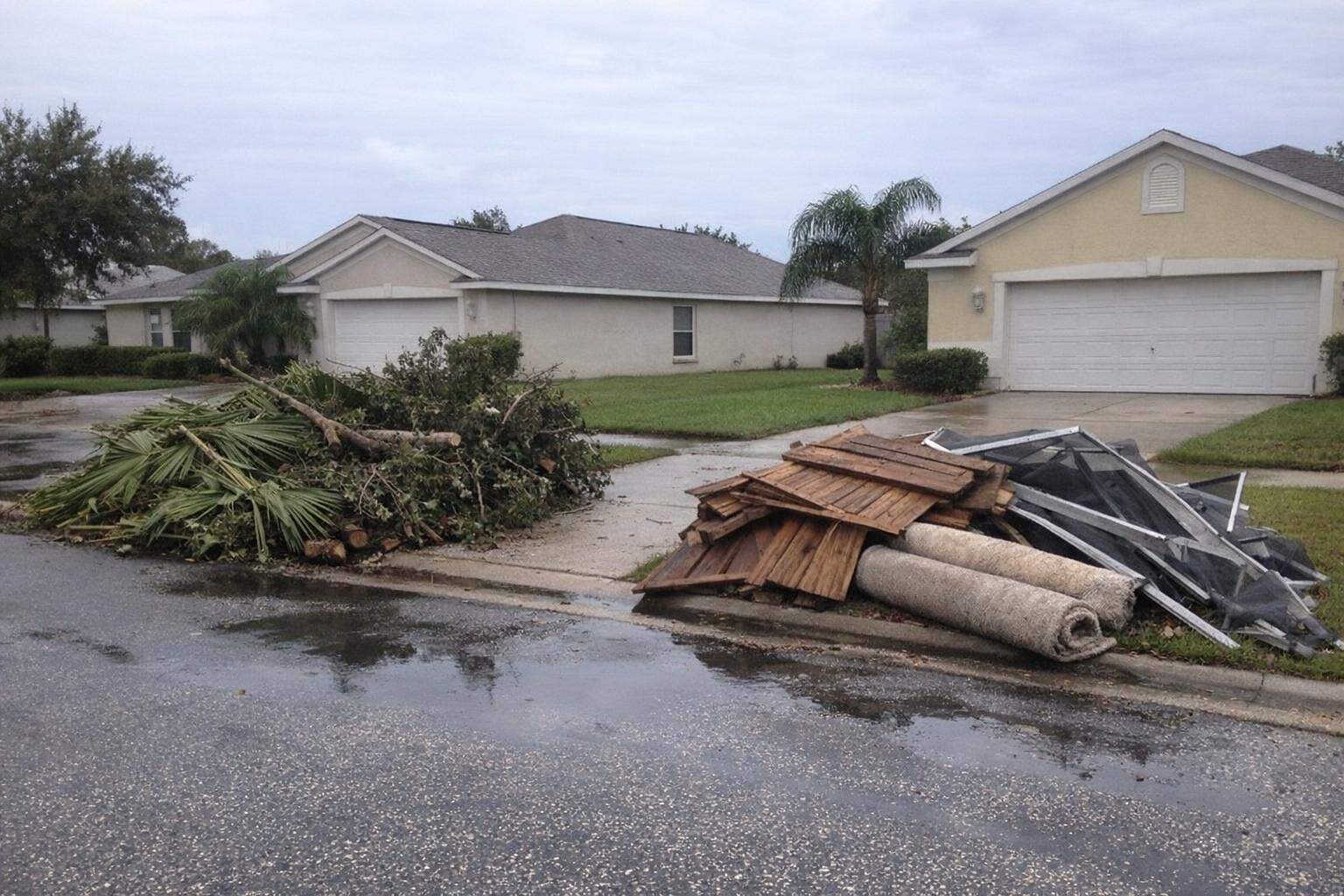
Yard Waste and Storm Debris Removal in Orlando
Limbs, fronds, fence panels, soaked carpet and screen frames hauled from Orlando yards and gated communities on your schedule. Send photos, get a price in writing, and pay when the pile is gone.
- Price agreed before loading
- Mixed piles taken as is
- Gated communities welcome
What yard waste and storm debris removal includes
A yard waste pickup arranged through this line covers the loading, hauling and disposal of green waste and storm damage from anywhere on the property, with the price fixed in writing before the first limb goes in the truck. The crew that takes the job brings the labor, the truck and the tarps. You point at the pile. Nothing has to be dragged to the curb first, cut to a county length or sorted by type, which matters most in the weeks after a hurricane when half the street has the same problem.
The haulers routed from here take the following from Orlando yards:
- Oak and pine limbs, palm fronds, trunk sections a crew can lift or roll
- Leaves, clippings, hedge trimmings, dead shrubs and uprooted plants
- Fence panels, posts and gates, with or without the hardware still attached
- Screen enclosure frames, torn screen, lanai furniture and broken patio sets
- Soaked carpet, drywall, insulation and flooring pulled after water intrusion
- Shingles, fascia, soffit, gutter runs and siding the wind took down
- Sheds that have collapsed or been taken apart, and small sheds the crew can dismantle
- Sandbags, tarps, and the general mess a yard collects after a storm
The can't-take list is short and it holds on every job:
- Gasoline, generator fuel and propane cylinders
- Paint, pool chemicals, pesticides and fertilizer
- Fluorescent tubes and anything with a circuit board that got wet
- Whole trees still standing and anything that needs a climber or a crane
- Stumps that need grinding
Fuel, paint, chemicals and bulbs go to the county's free household hazardous waste drop-off at the landfill on Young Pine Road or the Porter transfer station, Monday to Saturday from 8am to 5pm, with paint capped at 25 gallons per vehicle. Standing trees need a tree service; once a tree is on the ground and cut into sections, a hauler can take it from there.

How Orange County storm debris pickup works and what it refuses
Orange County collects storm debris after a declared event only when the pile is built its way, and a pile built any other way gets skipped. The county's emergency debris rules (ocfl.net) say vegetative debris and construction debris must sit in separate piles, and the exact wording is that if the two are mixed, neither will be picked up. A fence section tangled in a downed oak limb fails that test. So does a pile of fronds with a few pieces of soffit thrown on top.
The rest of the county checklist is just as specific. Limbs can be no longer than three feet and must weigh under 60 pounds each. Household garbage can never be mixed in. The pile goes at the edge of the property, clear of water meters, utility boxes, mailboxes and storm drains. Yard waste is never bagged after a storm. Debris a contractor generates, whether a roofer tearing off shingles or a fence company replacing panels, is never collected under the free program and has to be hauled by the contractor or by someone you hire.
The scale of the job explains the wait. After Hurricane Ian and Tropical Storm Nicole, the county's own newsroom reported on January 13, 2023 that the cleanup had collected about 355,000 cubic yards of debris across 7,940 truckloads using 96 trucks, and that effort ran from October into January. Hurricane season runs June 1 to November 30, and Orange County has been hit by Irma in 2017, Ian in 2022 and Milton in 2024. If your pile is mixed, oversized or sitting behind a gate, or you cannot wait for the county cycle, a paid hauler is the route that gets the yard back this week.
Why gated communities and condos arrange their own storm cleanup
The county cannot send its trucks into a private or gated community, so an HOA behind a gate owns its own storm debris problem. Orange County states plainly that it cannot remove vegetative debris from private or gated communities. The options the county gives an association are to carry the pile out to the public right-of-way beyond the gate, to request a county letter authorizing a private hauler to use a citizen drop-off site, or to arrange a county-designated roll-off, and all three leave the association doing the organizing. Communities approved after February 24, 2009 are required by county code to keep an HOA storm debris account for exactly this reason.
Condominiums, trailer parks and manufactured home communities where residents do not own the land are treated as commercial properties for debris purposes and have to arrange their own removal outright. Vacation rental managers around Kissimmee, Four Corners and ChampionsGate are in the same position, with the added pressure of guests arriving on a booked date. Osceola County alone has more than 30,000 vacation homes (Experience Kissimmee, July 2026), and a screened pool enclosure that came down in the wind cannot wait for a county truck that will never come.
For an association, the practical move is one hauler, one written price for the whole community pile or a per-load rate agreed in advance, and a receipt from the disposal site for the board's records. Board members and managers who call this line should say how many homes are affected, whether the debris is piled at a central point or at individual driveways, and what the gate code or guard arrangement is. Haulers routed from here handle the gate call and the paperwork the board needs, and the same applies to the commercial side of a mixed-use property, covered under commercial junk removal.
What happens to collected limbs and leaves at a compost facility
A short tour of how a public waste authority grinds and composts the yard debris it collects, which is where clean Orlando green waste is headed when it is kept separate from building material.

Video: Emerald Coast Utilities Authority on YouTube
How the price for yard and storm debris is worked out
Storm debris is priced by how much of the truck bed it fills, with the number agreed in writing before loading starts. The haulers routed from here quote in bed fractions: a minimum load, a quarter, a half, three-quarters or a full truck. A half truck means half the bed, and a decent crew shows you the bed before loading and again after so the fraction is something you saw rather than something you were told. Green waste is bulky and light, so a big pile of fronds can fill a truck fast; it is worth asking whether the crew will compact or cut it down, because that changes the fraction.
A few things move the number, and a straight hauler names them at quote time:
- Mixed loads. Fencing, shingles and drywall count as construction material at the landfill and cost more to dump than clean green waste.
- Heavy material. Wet carpet, soaked drywall, pavers and concrete footings from fence posts weigh far more than they look.
- Long carries. A pile at the back of a half-acre lot, or behind a pool enclosure with a narrow gate, takes more crew time than a pile at the driveway.
- Gate and access. A guard gate, a locked community or a steep lake lot adds time.
- Dismantling. A collapsed shed or a screen enclosure that has to be cut apart before it fits in the bed is quoted as labor on top of volume.
Here are the national ranges that frame what a typical job costs. Every figure is a typical range confirmed by your own written estimate.
| Load | Typical national range | Source |
|---|---|---|
| Minimum load (about 60 cubic feet) | $75 to $125 | Fixr, January 2025 |
| Average junk removal job | About $300, typical range $150 to $600 | Fixr, January 2025 |
| Average per load | $150 to $350 | HomeGuide, May 2024 |
| Full truckload | $450 to $650 | Fixr, January 2025 |
| 10-yard dumpster, one week | $200 to $550, $380 average | Fixr, January 2025 |
A yard that took a direct hit can run past one truckload, and a hauler who sees the photos should say so up front and price the second load before the first one leaves. There is no deposit. You pay when the pile is on the truck and the yard is raked.
What you can do for free first in Orlando
Routine yard waste and a modest storm pile can go out for free in both the city and the unincorporated county, and it is worth using that allowance before paying anyone. City of Orlando residents have a weekly yard waste day. Unincorporated Orange County residents (ocfl.net) get weekly large item and yard waste collection on the same day, limited to three cubic yards per household per week, set out before 6am. Three cubic yards is roughly a pile the size of a small car's trunk stacked three times over, so a hedge trim fits and a downed oak does not.
You can also haul it yourself. The Orange County landfill at 5901 Young Pine Road takes yard waste, and the Porter transfer station on Good Homes Road and the McLeod Road transfer station accept yard waste on Saturdays only. The landfill is the only county site that takes construction and demolition debris, which is where fence panels, shingles and drywall belong, at $42.70 per ton with a $10 minimum charge under the rates effective October 1, 2026. An uncovered load is charged double, so bring a tarp and straps.
A paid hauler is the better call in four situations. The pile is bigger than three cubic yards and you do not want to feed it to the curb a week at a time. The pile mixes green waste with fencing, screen or building material and would be refused under the storm rules. The property sits behind a gate, inside a condo association or in a vacation rental where the county will never come. Or the timing matters: the yard is a hazard, the HOA has sent a letter, or guests are arriving, and same-day and next-day pickups are available on this line. Many Orlando HOAs also limit how long a pile may sit at the curb, which turns a free program into a fine if the county cycle runs long.
The county left part of my storm debris, who do I call?
The county trucks skip whatever fails their rules, and a private hauler is the route for whatever got left. The pattern after a storm in Orlando is familiar: the vegetative pile gets picked up, and a fence section with screws in it, a roll of soaked carpet or a tangle of screen frame is still sitting there weeks later because it counted as construction debris or because it was mixed with the limbs. A 311 report can get the street re-run for the vegetative portion. The building material portion was never on the county's list, and contractor debris never is.
Calling (407) 326-0014 with a couple of photos of what remains gets a written price for that remainder, whether it is a half truck of fence panels or a single load of lanai screen and broken furniture. Whoever attends takes the mixed pile as it sits, so there is no re-sorting on your part. If you are embarrassed that the yard still looks like the storm was last week, you are in a long line, and the crew has seen worse on the same street. The point is to get it gone. For debris from the inside of the house, torn-out drywall, flooring and cabinets, the construction debris removal page covers how that load is priced and where it goes.
How much does it cost to have the backyard completely cleaned out?
A full backyard clearout in Orlando is priced the same way as any other load, by the fraction of the truck it fills plus the adjustments for weight, access and dismantling, and most jobs land inside the national ranges above once the pile is photographed and quoted in writing. A yard that holds years of fallen fronds, a dead hedge line, a rotting fence, an old swing set and a rusted grill fills a truck faster than people expect because green waste does not stack tight. The swing set and the grill add metal that the hauler can route to a recycler, and the fence adds construction material at the landfill rate.
The way to get an honest number is to send a wide shot of the whole yard, a close shot of anything heavy or metal, and a note about the gate width and how far the truck can get from the pile. The hauler we route then quotes a bed fraction and names the add-ons in writing. If the job is likely to go past one load, that gets said before the truck arrives rather than after the first load is full. Sunday work is by arrangement, and pickups run 7am to 7pm Monday to Saturday. Some backyard clearouts include a pulled-out spa, which is its own job covered under hot tub removal.
Where Orlando yard waste and storm debris ends up
Clean green waste from an Orlando yard is ground and composted or mulched, construction material goes to the Orange County landfill, and metal from fences and frames goes to a scrap recycler. The county's landfill on Young Pine Road accepts yard waste as its own stream, and the transfer stations take it on Saturdays. Keeping it separate from building debris is what lets it be ground instead of buried, which is the same reason the county's storm rules insist on two piles. Fla. Stat. 403.708(12) also restricts burying yard trash in lined Class I landfills, so a hauler who mixes everything into one load is paying a higher rate and putting compostable material where the state says it should not go.
The landfill is under pressure. Florida DEP's 2024 disposition figures show Orange County collected 4,199,080 tons of municipal solid waste, landfilled 70 percent of it and recycled 30 percent against the state's statutory 75 percent goal, and DEP's capacity study estimated in October 2024 that the Young Pine Road landfill had about 14 years of permitted airspace left. That is one more reason a crew sorts the load instead of tipping it all in one hole.
Dumping it in a wooded lot or a retention pond edge is the one route to rule out. Under the Florida Litter Law, Fla. Stat. 403.413, dumping more than 500 pounds or any commercial quantity is a third-degree felony with a fine up to $5,000 under s. 775.083, 15 to 500 pounds is a first-degree misdemeanor with a fine up to $1,000, and even 15 pounds or less draws a $150 civil penalty. A storm pile passes 500 pounds in one truck. Ask the hauler where the load is going and request the disposal receipt; a legitimate crew expects the question.
What to check on the hauler before the truck rolls
Five checks separate a hauler worth hiring from a pickup truck that showed up because of a storm, and all five take under a minute. Florida has no state license for junk hauling, so nobody can show you one. The haulers routed from here operate under an Orange County Business Tax Receipt and carry liability insurance, and you should ask whoever attends for proof of insurance before a crew walks under a damaged screen enclosure or carries heavy material across a wet lawn.
- Proof of insurance, shown on request, from the crew that takes the job.
- The price in writing before anything is loaded, stated as a bed fraction plus named add-ons.
- The can't-take list repeated at quote time, so nobody argues about a fuel can at the door.
- Where the load is going, by name, with a disposal receipt available.
- No deposit. Payment by card or invoice when the yard is clear, and tips never expected.
After a hurricane the metro fills with out-of-town trucks and unmarked trailers. A written price and a named disposal site are the two things that stay the same whether the storm was last week or last year. You can read how the line is run on the about page or send photos through the contact page.
The services that usually sit beside this one
Most Orlando pickups mix two or three of these, and the pages below describe the ones that most often ride on the same truck.
- Construction Debris Removal: Drywall, tile, lumber and torn-out fixtures hauled to the one county site that takes them.
- Commercial Junk Removal: Office, retail and restaurant cleanouts scheduled around the hours the business keeps.
- Hot Tub Removal: Drained, disconnected, cut into sections and hauled out through the lanai or the gate.
After a storm the fence, the lanai screens and the soaked carpet all need a route, and the about page covers how one call arranges them.
How a storm debris pickup gets arranged
From the first call to the swept yard, each step is set up so the number you agree to is the number you pay.
-
Call or send photos
Phone (407) 326-0014 or send a wide shot of the pile and a note on gates, distance and anything heavy. The line is answered seven days a week.
-
Get the price in writing
The hauler we route replies with a bed fraction, the add-ons by name, and whether the pile is likely to run past one load. Nothing is loaded until you say yes.
-
Pick the slot
Pickups run 7am to 7pm Monday to Saturday, with Sunday by arrangement. Same-day and next-day pickups are available when a truck is free.
-
Watch the bed fill
The crew shows the bed before loading and after. Green waste, fencing and metal are loaded so each goes to the right place.
-
Pay when the yard is raked
The load leaves, the yard is raked, and you pay the agreed amount by card or invoice. A disposal receipt is available on request.
Why Orlando homeowners and HOAs book storm debris through this line
After a hurricane the question is whether the pile leaves this week and whether the price holds, and both are handled before the truck is dispatched.
Mixed piles the county will skip are taken as they sit
Orange County's storm rules refuse a pile that mixes limbs with fence panels, shingles or screen, and contractor debris is never collected. The haulers routed from here load the mixed pile as it sits, separate green waste from building material on the truck, and dump each at the right rate. You do not re-sort a yard the storm already made a mess of.
Orange County emergency debris rules: if vegetative and construction debris are mixed, neither will be picked up (ocfl.net).
Gated communities, condos and rental managers get a single written price
The county cannot enter a private or gated community and treats condos and manufactured home communities as commercial, so associations and vacation rental managers arrange their own cleanup. A board gets one hauler, one price per load agreed in advance, and a receipt from the disposal site for the records, which is what a post-2009 community's storm debris account is there to fund.
Orange County code requires communities approved after February 24, 2009 to keep an HOA storm debris account (ocfl.net).
The number is fixed before the first limb is loaded
A yard pile is quoted as a fraction of the bed with every add-on named, and the crew shows you the bed before and after. If the pile looks like two loads, the second load is priced before the first one leaves. No deposit, and payment only when the yard is raked. The county's own cleanup after Ian took from October into January; a private pickup is the alternative to that wait.
Orange County collected about 355,000 cubic yards of debris in 7,940 truckloads after Ian and Nicole (Orange County newsroom, January 13, 2023).
What Reddit Says About Storm Debris Removal in Orlando
The one Orlando-local thread on this subject is about the gap the county leaves. After Hurricane Milton, posters in unincorporated Orange County said the county trucks had left large portions of their debris behind six weeks on. A 311 report got one street re-run. A blown-down fence section with screws still in it was skipped outright. The takeaway people landed on was that anything mixed, anything with metal in it, and anyone who cannot wait out the county cycle needs a private hauler.
On pricing, the complaint from other cities is that a national franchise wanted hundreds of dollars for a pile of twigs because the quote was based on truck volume and light green waste fills a bed fast. Operators replying in those threads pointed out that yard waste is cheaper to dump than construction waste, which is why a hauler should quote a clean green pile differently from a pile with fencing in it. For a full backyard cleanup with scrap mixed in, operator estimates in one thread ran from about $750 to $1,250 as fair, with one saying anything under $500 would be shocking. Those are what people reported in their own cities and years, and the written estimate is what applies here.
The vetting advice is the same as for any pickup. Send photos, get a firm number, pay that number. Ask whether the crew comes into the yard and behind the gate or expects the pile at the curb. Ask for proof of insurance before anyone works under a damaged enclosure. Ask where the load is going and for the dump receipt, because illegal dumping is the fear that justifies paying more and one poster was tracked down from a dumped item with their name on it. And ask who shows up, since a booking handed off to strangers in a pickup is a named red flag.
Every one of those questions has a plain answer on this line before a truck is sent.
A typical storm debris call from a gated community in Dr. Phillips
The situation: A gated subdivision off Apopka-Vineland Road comes out of a hurricane with oak limbs across the roads, four or five screen enclosures down, a stretch of perimeter fence flat on the ground and fronds in every driveway. The county cannot send trucks through the gate, and the HOA manager has residents asking why the pile at the clubhouse is still there a week later.
What gets done: The manager calls with photos of the central pile and a count of the affected homes. The hauler we route quotes a per-load bed price in writing, with the fencing and screen frames priced as construction material and the limbs as green waste, and the manager approves it by reply. A crew works the central pile first, then the individual driveways, loading limbs and fronds separately from the aluminum screen frames and fence panels so each goes to the right site. The gate code and guard arrangement are sorted on the first call.
How it turns out: The community's debris leaves over a couple of days instead of waiting on a county cycle that was never coming. The board gets the disposal receipts and a load count for its storm debris account, pays on the agreed per-load number, and the residents stop asking.
Yard waste and storm debris questions from Orlando
These are the questions people in Orlando ask after a storm and after a big yard project, answered the way a hauler would answer them in the driveway.
Call (407) 326-0014The county left part of my storm debris. Who do I call?
Call (407) 326-0014 with a photo of what is still sitting there. The county trucks skip anything that fails their rules, so what remains is usually a fence section, soaked carpet, screen frame or a pile where limbs and building material were mixed. A 311 report can get the vegetative portion re-run, but the construction material was never on the county list. The hauler we route takes the remainder as it sits, quotes it in writing as a bed fraction, and hauls it on a slot you choose.
How much does it cost to have the backyard completely cleaned out?
Most full backyard clearouts fall inside the national ranges, where Fixr puts a typical junk removal job between $150 and $600 and a full truckload at $450 to $650 as of January 2025. The real number depends on how much of the bed the pile fills, how heavy it is, how far the crew carries it and whether a fence or shed has to be dismantled. Send a wide photo and a note on access, and the price comes back in writing before anything is loaded.
Do I have to separate limbs from fence panels and shingles?
You do not have to separate anything for a paid pickup. The county's free storm program requires vegetative and construction debris in two piles and refuses both if they are mixed, and that is the rule that leaves so many Orlando piles sitting. A hauler takes the mixed pile as it is and sorts it on the truck so green waste goes to be ground and building material goes to the landfill. Mixed loads do cost a little more than clean green waste because the landfill charges by material type.
Can a hauler get into a gated community or a condo?
Yes. Gated and private communities are the main reason this service exists after a storm, because Orange County states it cannot remove debris from inside them, and condos and manufactured home communities are treated as commercial and must arrange their own removal. Give the dispatcher the gate code or guard contact, say whether the debris is piled centrally or at each home, and ask for a per-load price in writing. The board gets disposal receipts for its records.
Will the hauler take gasoline, paint or pool chemicals that got knocked around in the storm?
No. Fuel, propane, paint, pesticides, pool chemicals and fluorescent tubes stay on the can't-take list, and the crew will say so again at quote time so there is no argument at the door. Orange County residents can drop all of those for free at the household hazardous waste sites at the Young Pine Road landfill and the Porter transfer station, Monday to Saturday, 8am to 5pm, with paint and chemicals limited to 25 gallons per vehicle. Tires are refused at the hazardous waste sites and go to the landfill at $3 each.
How quickly can a truck come after a storm?
Same-day and next-day pickups are available when a truck is free, and the phone is answered seven days a week. In the first days after a hurricane demand is heavy across the metro, so the honest answer is that the dispatcher will tell you the first open slot rather than promise a time. Pickups run 7am to 7pm Monday to Saturday and Sunday by arrangement. Sending photos with the first call speeds everything up because the price can be written before the slot is booked.